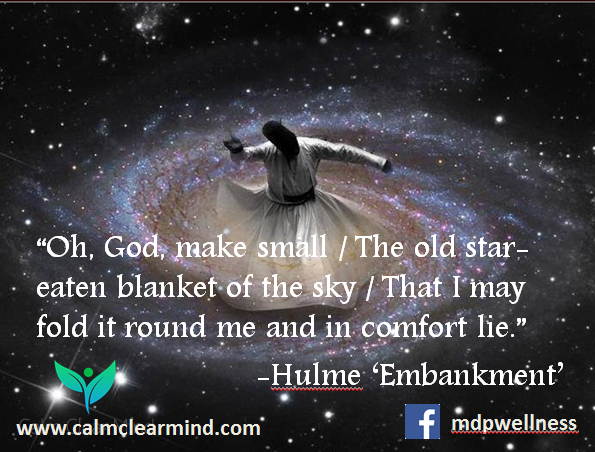
Fairytales feed our minds with the enchanted thoughts about finding a situation where our wishes are fulfilled and we live "happily ever after." Contrary to this belief, happiness is not something to go out and find. Happiness is made (with focus and effort) from within. Following the guidance of researchers and masters in wellbeing we can extract these key points:
1. Accept the unfamiliar.
If you only find value in what you know well and ignore or dislike everything unfamiliar, you may be passing up on life's diamonds. Open yourself up to learning new perspectives. "Novelty, or exposing ourselves to new ideas and experiences, promotes the growth of new connections among existing neurons," Daniel J. Siegel explains in Mindsight. Siegel explains how the brain and personality forms and transforms as we incorporate new behaviors. Openness to a new practice such as meditation that focuses on balance and fulfillment can not only give you a new experience, but can change your personality to becoming a harmonious, happy person.
As Bob Dylan puts it, "He not busy being born is busy dying." Life is growth and linked to happiness through the joy of expanding our abilities. For example, learning a new specialty, language or other ability brings greater pleasure than limiting yourself to continuing to only do what you know. Like a coal miner who knows and depends on the value of coal, if he is open to find something "not coal" he may find a diamond.
Open up and expand yourself towards happiness.
2. Activate your intuition.
Not everything is figured out rationally. In fact, sometimes we can use logic to disclaim truth. (Think of the rational belief people once had that the world is flat and had an edge to fall off. Thankfully, someone had an intuition that opened up new territories. )
For those of us that have been so schooled to only trust knowledge that comes from books or backed by scientific studies, we could access meaningful wisdom by listening to intuition. "The intuitive way of perceiving has always put me in touch with the effortless, truly joyful nature of life and showed me how, when we approach our experiences with childlike innocence and awe, miracles abound," delights Penny Peirce, intuitive development trainer in the introduction of her book, The Intuitive Way.
Learning the wisdom you have inside can begin filling you with joy.
3. Mindfully sort through information.
We are constantly bombarded with information. Deciding what we take in either moves us toward happiness of derails us into depression. Be conscious of the underlying direction of the information that you take in from the books you read, shows you watch and conversations that you participate in. Ask yourself, "Is the message here moving me towards hopefulness and compassion or hopelessness, fear and anger?"
Hope and compassion encourages us to connect into viable support systems with others, allowing for greater possibilities in collaboration. "Mindfulness can also be described as compassion, because it is an empathetic awareness," as explained in the book, Mindfulness by Mark Williams, John Teasdale, Zindel Segal and Jon Kabat-Zinn. The authors, professors and researchers in psychology and medicine, explain that depression is overcome by empathetic awareness. When we create bonds of caring with others, those bonds build our secure sense of self.
Stories, real or fiction, that describe love and caring stimulate our internal position to the mindful compassionate state of being. Choose to expose yourself to the friends, news, shows, books and other media that convey hopeful accounts.
4. Use language carefully.
What we say forms our thinking and eventually our actions. For those who speak different languages, you know that a different way of thinking accommodates the tongue.
In the English language we experience words that call for harmony from Martin Luther King Jr, words that inspire courage from Winston Churchill and words that evoke passion from William Shakespeare. In our personal lives, we recall encouraging words of a parent, teacher or coach that carry us through challenges. We probably recall how a criticism was phrased in a supportive way or in a style that crushed us.
The language we use to describe others and ourselves forms thoughts and behaviors that shift our identity. "Words will and do influence your actions. They start the painting of your self-projection to others and reinforce this image within," David Fastiggi reminds us in Your True Identity. We tend to follow the words we say about ourselves into becoming our personality.
5. Appreciate who you are.
Recognize the positives of your qualities. All qualities have a plus side and aspects that can irritate others. Instead of focusing on wanting to change your qualities, change the way you use your qualities. Appreciating yourself facilitates your ability to love, respect and value others as well.
"Everything, even your success issues and your circumstances, boils down to whether you are in an internal state of fear or an internal state of love," Alexander Loyd clarifies in his recently released book, Beyond Willpower: The Secret Principle to Achieve Success in Life, Love and Happiness. Compassionate acceptance of yourself with love frees you to make choices towards fulfillment and happiness. The small choices we make based on love or fear accumulate to the life we build. Therefore love yourself.
AND as you appreciate who you are, do the same for others. We are mirrors to one another.
Source
1. Accept the unfamiliar.
If you only find value in what you know well and ignore or dislike everything unfamiliar, you may be passing up on life's diamonds. Open yourself up to learning new perspectives. "Novelty, or exposing ourselves to new ideas and experiences, promotes the growth of new connections among existing neurons," Daniel J. Siegel explains in Mindsight. Siegel explains how the brain and personality forms and transforms as we incorporate new behaviors. Openness to a new practice such as meditation that focuses on balance and fulfillment can not only give you a new experience, but can change your personality to becoming a harmonious, happy person.
As Bob Dylan puts it, "He not busy being born is busy dying." Life is growth and linked to happiness through the joy of expanding our abilities. For example, learning a new specialty, language or other ability brings greater pleasure than limiting yourself to continuing to only do what you know. Like a coal miner who knows and depends on the value of coal, if he is open to find something "not coal" he may find a diamond.
Open up and expand yourself towards happiness.
2. Activate your intuition.
Not everything is figured out rationally. In fact, sometimes we can use logic to disclaim truth. (Think of the rational belief people once had that the world is flat and had an edge to fall off. Thankfully, someone had an intuition that opened up new territories. )
For those of us that have been so schooled to only trust knowledge that comes from books or backed by scientific studies, we could access meaningful wisdom by listening to intuition. "The intuitive way of perceiving has always put me in touch with the effortless, truly joyful nature of life and showed me how, when we approach our experiences with childlike innocence and awe, miracles abound," delights Penny Peirce, intuitive development trainer in the introduction of her book, The Intuitive Way.
Learning the wisdom you have inside can begin filling you with joy.
3. Mindfully sort through information.
We are constantly bombarded with information. Deciding what we take in either moves us toward happiness of derails us into depression. Be conscious of the underlying direction of the information that you take in from the books you read, shows you watch and conversations that you participate in. Ask yourself, "Is the message here moving me towards hopefulness and compassion or hopelessness, fear and anger?"
Hope and compassion encourages us to connect into viable support systems with others, allowing for greater possibilities in collaboration. "Mindfulness can also be described as compassion, because it is an empathetic awareness," as explained in the book, Mindfulness by Mark Williams, John Teasdale, Zindel Segal and Jon Kabat-Zinn. The authors, professors and researchers in psychology and medicine, explain that depression is overcome by empathetic awareness. When we create bonds of caring with others, those bonds build our secure sense of self.
Stories, real or fiction, that describe love and caring stimulate our internal position to the mindful compassionate state of being. Choose to expose yourself to the friends, news, shows, books and other media that convey hopeful accounts.
4. Use language carefully.
What we say forms our thinking and eventually our actions. For those who speak different languages, you know that a different way of thinking accommodates the tongue.
In the English language we experience words that call for harmony from Martin Luther King Jr, words that inspire courage from Winston Churchill and words that evoke passion from William Shakespeare. In our personal lives, we recall encouraging words of a parent, teacher or coach that carry us through challenges. We probably recall how a criticism was phrased in a supportive way or in a style that crushed us.
The language we use to describe others and ourselves forms thoughts and behaviors that shift our identity. "Words will and do influence your actions. They start the painting of your self-projection to others and reinforce this image within," David Fastiggi reminds us in Your True Identity. We tend to follow the words we say about ourselves into becoming our personality.
5. Appreciate who you are.
Recognize the positives of your qualities. All qualities have a plus side and aspects that can irritate others. Instead of focusing on wanting to change your qualities, change the way you use your qualities. Appreciating yourself facilitates your ability to love, respect and value others as well.
"Everything, even your success issues and your circumstances, boils down to whether you are in an internal state of fear or an internal state of love," Alexander Loyd clarifies in his recently released book, Beyond Willpower: The Secret Principle to Achieve Success in Life, Love and Happiness. Compassionate acceptance of yourself with love frees you to make choices towards fulfillment and happiness. The small choices we make based on love or fear accumulate to the life we build. Therefore love yourself.
AND as you appreciate who you are, do the same for others. We are mirrors to one another.
Source